I have never made an instrumental with samples like these and it was honestly quite refreshing. I would normally choose samples that are a bit more dark or emotional but I feel such a major-ish sample made me use different techniques than I normally default to. I really liked the atmospheric feel of the soundscape in the back and I think I will take that technique into my future productions. As far as the text to speech engine goes I don’t think it was very successful. I recorded it late at night so I wasn’t speaking very loud or clearly but thought it would be alright. The next morning I had to leave London for a week but I didn’t have my SP with me so couldn’t rerecord and was thereby stuck with the original recording. I think the idea of cutting up phonemes from interviews instead of my own voice excites me much more anyway so I don’t really mind that this attempt was a flop. Another reflection I had may not make sense but… I don’t really listen to music like this so I have nothing to judge it against and therefore no way to tell if it’s good or not. I have listened to so much hip-hop in my life and made so many beats that I know whats hot from not which isnt the case here. is it electronic? beats me. Regarding the text to speech sound study – I feel like it didnt quite feel right over the top so I cut out most of it and just used it as an intro but I think the message still gets across. If I had more time to complete the composition (if i started earlier) I would have liked to have made it develop more and have followed a more typical song structure. I also wanted to make a bass layer. But overall i’m very happy with this piece because of all the new techniques I explored and lessons learnt!
Category: Audio Fundementals
-
Audio Fundamentals Part 2: The Composition
My sonic identity is 100% sampling. I find no thrill in synthesising or recording sounds myself because I feel there’s no story to it. I’ve found this really difficult in this unit which has been so heavily centred around exploring field recorders and microphones and none of it excites me. What excites me is turning existing sound and making it your own, exploring the infinite world of existing recordings, musical or otherwise, and repurposing them into new compositions. Which is why in this composition I wanted to make the instrumental using strictly my classmates recordings, and creative sampling techniques to totally abstract them from their original sources without using additive effects like Corpus or Vocoder. Fortunately in the soundwalk with Jose at Forest Hill, Phia, Angel and Ines recorded these marimba-like tubes which I was able to use for the melodic elements. I love making samples glitchy with Ableton’s ‘Beat’ warp algorithm stretched out because it makes this choppy revered sound that I prefer over more accurate engines like ‘Complex’ that can end up sounding quite grainy. So I played with the pitch and timestretching using warp on the Marimbas and resampled that into a new recording that I dropped into Simpler. I put an arpeggio behind it and recorded myself jamming on my computer keyboard with different chops playing at different speeds and rhythms and cut that up to find the best bits and make different loops for the different sections of the composition.
For the kick I used the low frequency content of Lewis’ ‘Spinning’ recording from the same trip and compressed it to give it a punchier attack and EQed it to make it less airy and more subby. I really like the sonic qualities of this and think it sits really nice with the sound of the melody.
I made the percussive elements from another recording from Phia, Angel and Ines of them recording a pond with a hydraphone. There were so many cool textures in this and I layered a bunch to make a snare type sound alongside some EQ and compression. I made the hat out of another texture in this recording except pitched way up to bring out more high end qualities. I also made a block soundy thing with the sound of a raindrop that comes in toward the end of the composition and made the bassline out of a heavily pitched down and tuned waterdrop. To contrast, I added Zac’s recording of the general soundscape and left it unchopped, only adding an EQ, reverb and delay. -
Audio Fundamentals Assignment: Part 1 – The Extract
The extract I’m going to be using is a short phrase from Sound Unbound, a book that I’ve found super resonant with me in comparison to a lot of other Sound Art literature, which has been really grounding when feeling lost in Sound Art. When I read ‘Samplers Make It Possible’ in the segment written by Steve Reich it really hit me hard because my whole interest in music entirely stems from samplers and sample based music and my music is such a important part of my life and samplers make that possible. As it’s such a short phrase I saw it as an opportunity to make something creative out of the recording. I previously had the idea to make a text to speech generator with my MPC and cutting up phonemes from various interviews to give it a janky, glitchy sound and I wanted to make a prototype of that idea by manipulating the phonemes in the phrase ‘Samplers Make It Possible’ to sound artificial and computer generated. I’ll record myself reading it a few times into the onboard mic of my SP404 (a sampler that played a huge role in the beat scenes that define my sound) to give myself a high chance of cleanly capturing each phoneme of the phrase. The mic is obviously poor quality but it’s a deliberate choice as the omission of a high quality mic parallels my refusal of microphone culture and gear over idea.
I’ll record the SP404 mic straight into the MPC and chop up each individual phoneme and put it into a ‘drum program’. After setting up loop points of each phoneme to make them endless I’ll recreate the rhythm of each word in respective MIDI sequences then duplicate the sequences and play around with the envelopes and pitch and MIDI event timings of each phoneme to make a few variations of each word. I’ll then ‘jam’ with the program over the instrumental, making it like an abstract ‘multisampled’ instrument / poem. I like this idea because it serves as a constant reminder that the track is 100% made with samples and I feel so strongly that people misrepresent sampling as stealing or lazy when it can really be the most expressive and intentional way to make music. -
Text-to-speech research + brainstorming
This week I’ve been researching text to speech engines and how to go about making one myself. I regularly use the legacy voices from the built-in Mac TTS reader and love to sample them in my music. I think this is inspired heavily by Madlib (like much of my sound/ethos) most notably in his reggae mixes Blunted in the Bomb Shelter and 420 Chalice Allstars, as well as his instrumental mixtape series’ Mind Fusion (vols 1-5). My initial idea was to create an installation of 44 sculptures that each create a phoneme with a mix of acoustic and electronic sources. An example of an acoustic phoneme would be a sculpture with 2 wood blocks that clack together to make a T sound, while the electronic sounds would be prerecorded phoneme sounds played out of tiny tiny speakers within their respective sculptures. Then the audience would interact by typing whatever they want into a computer in the room that would convert the text into MIDI which is then sent to the various sculptures around the room to hopefully create a janky pronunciation of the phrases chosen. The more I looked into it the more ambitious of a project it seemed to be so I thought about scaling it down to just be software based and leave the sculptures for after I wrap my head around the whole text to MIDI thing. My research into this began by looking into legacy TTS models for 2 reasons; a) the sonic qualities of these are what inspire me the most, and b) I assumed they would be simpler to recreate as they sound more rudimentary. I landed on Microsoft Whisper as my first engine but was soon struck by this quote “which were isolated by cutting digital waveform recordings of the human voice into sections” which inspired me to lean into my special interest of sampling and dig for interviews that mean something to me in which I can chop up the phonemes and resulting background noises to make a janky and glitchy speech engine. I would do all the chopping on the MPC and make a program in which I can individually manipulate the envelopes, pitch and loop points of each phoneme. After setting up the program I’ll write a script for the text input and midi conversion in Lua for the Norns which is the part I haven’t fully wrapped my head around yet but I know is fully possible. In the meantime I will make the MPC program and demo the actual sounds to make sure the sound engine part is what i’m envisioning and address any potential discrepancies between my idea and the outcome.
-
Contact Mic Workshop
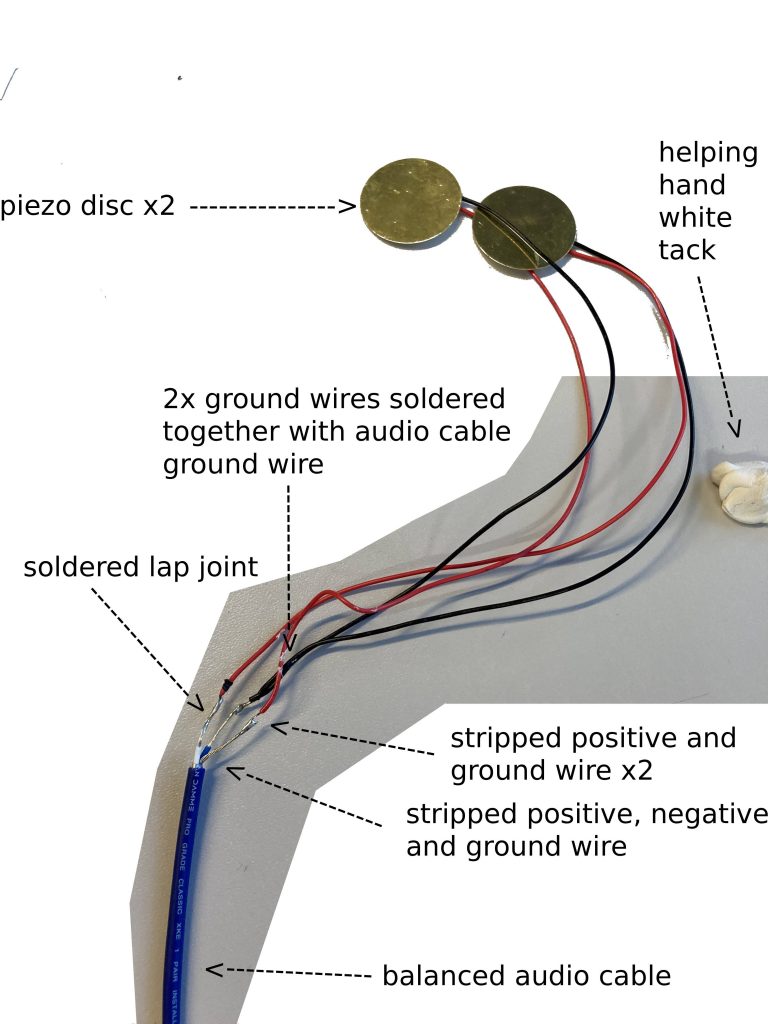
Unfortunately I was unable to finish my contact mic! Due to all the smoke from all the soldering going on, the fire alarm went off before we were able to wire up the jacks and test them out. I’m not sure what happened with the rest of the class but I had to leave at 2 to catch a train by which point there was no sign of returning to the classroom so my mic didn’t develop beyond this photo:
-
Extract Recordings
“Steady B’s ‘I’ll Take Your Radio’ underlines the escalating potency of Music Technology that accepted and celebrated life lived Fluidly and openly, on the streets, on the move.” – Sound Unbound
I spend at least 2 hours on the Tube a day. The tube is a defining characteristic of London that I wouldn’t be able to live here without, since I’m crashing with my Uncle and Auntie (Zio and Zia) in Barnet. I wouldn’t exist without this city. Neither of my parents would have ever came to the UK if it wasn’t for London, and they would have never met in that bus stop. I wouldn’t be in London if I wasn’t able to stay with my Zio and Zia, which is the exact same scenario 30 years ago for my mum. She wouldn’t have been able to leave Sicily to come to London if it wasn’t for her brother and his Girlfriend, and her mum letting my mum stay at her house in Barnet rent free which is exactly the privilege I have right now. The cost of a commute is the cost you have to pay coming from a medium income family to London. Student finance doesn’t cover student accommodation, and household income can’t make up for that money lost either. The endless music I can listen to thanks to technical progression makes all my journeys that much more special.“Online, everything is a sample. Every audio element becomes a potential fragment for manipulation and recontextualisation.” – Sonic Processes (At the studio)
My music practice is 100% manipulating samples found on the internet; no records, no synthesisers. It has always been like this and likely always will be. I’m recording this at the desk which has been with my auntie for as long as she can remember, and which my MPC1000 currently lives. It’s my favourite sampler I have ever used and it’s older than me. Which ties to the next excerpt:
“By the 2030’s – 40’s, if current rates continue, consumers will discard in excess of 100 million tonnes of electronic devices globally per year. More than just sheer mass, these discarded electronics, are also allegories. Stories about them narrate dreams of shiny technological futures and nightmares of social and ecological breakdown.”
I recorded this excerpt in one of LCCs high spec Mac Studios. What happened to the last computers? Do you need the newest computer for music production? My MPC is from 2003 and is fully repairable and customisable; I’ve installed an XL screen and a new faceplate as well as fixed some unresponsive tact switches. The new MPCs can’t do this. As far as modern technology, I have a base spec M1 MacBook Air that I’ve had for half a decade that has never hiccuped on me once. Ive made hundreds and hundreds of songs on it and plan to make hundreds and hundreds more. I just wonder how old the last computers were before an upgrade was nessecary?
What I found interesting about these recordings is how much external noise was picked up in rooms that I can hear my ears ring in. There’s so much noise around us that we tune out. I also imagined myself speaking at the same volume in each space but my tone of voice changed drastically with the noise levels of the atmosphere around me. I also think my lack of confidence on the mic is evident in how much you can hear my voice trembling in the quieter recordings.
-
Vision Statement
I make electronic infused hip-hop. Some instrumentals lean more experimental and others more raw (like when i’m working on my MPC1000). I think a defining technique of mine is how granularly I chop samples, I like to chop every note of a sample and every drum hit, and then through creative looping techniques, extend each sound to have full control of reconstructing the pieces into my own sound collage. I work exclusively with samples. I see this as a creativity breeding limitation that constricts what I can do in a song to what puzzle pieces I can find and how I can put them back together. In the future I would like to develop my practice in a mixed media direction. I want to:
- explore live performance in unconventional and inventive ways using DIY hardware and genre bending set lists.
- explore how far you can push the art of music distribution and have a prolific period of releases where I explore obscure physical (interactive mixtapes, limited physical media runs, art installation album promotions etc.) and digital distribution methods (website scavenger hunts, internet radio listening parties, pirate radio soundscapes etc.).
- become more confident as a vocalist and in live performance
- adopt a sound art way of thinking to my work
I see all of this as very possible with a healthy dose of exposure therapy and practice!
-
Elevator Pitch
Hi. Ben Here, AKA Dr. Fylebite AKA Skidmaster Flake AKA djjobcenterplus AKA Machine Gun Money AKA Supreme Von Mundy.
I’m 19 and started making beats during lockdown. Since then i’ve made several beat tapes/albums, organised and sold out an album release party, built a soundsystem using the funds made from said event, which I couldn’t afford to continue with, so sold that and built a studio in my garden with my dad. I make hip-hop and want to take my music to a more experimental and multimedia direction using electronics, sculpture and web design. Thanks for listening